


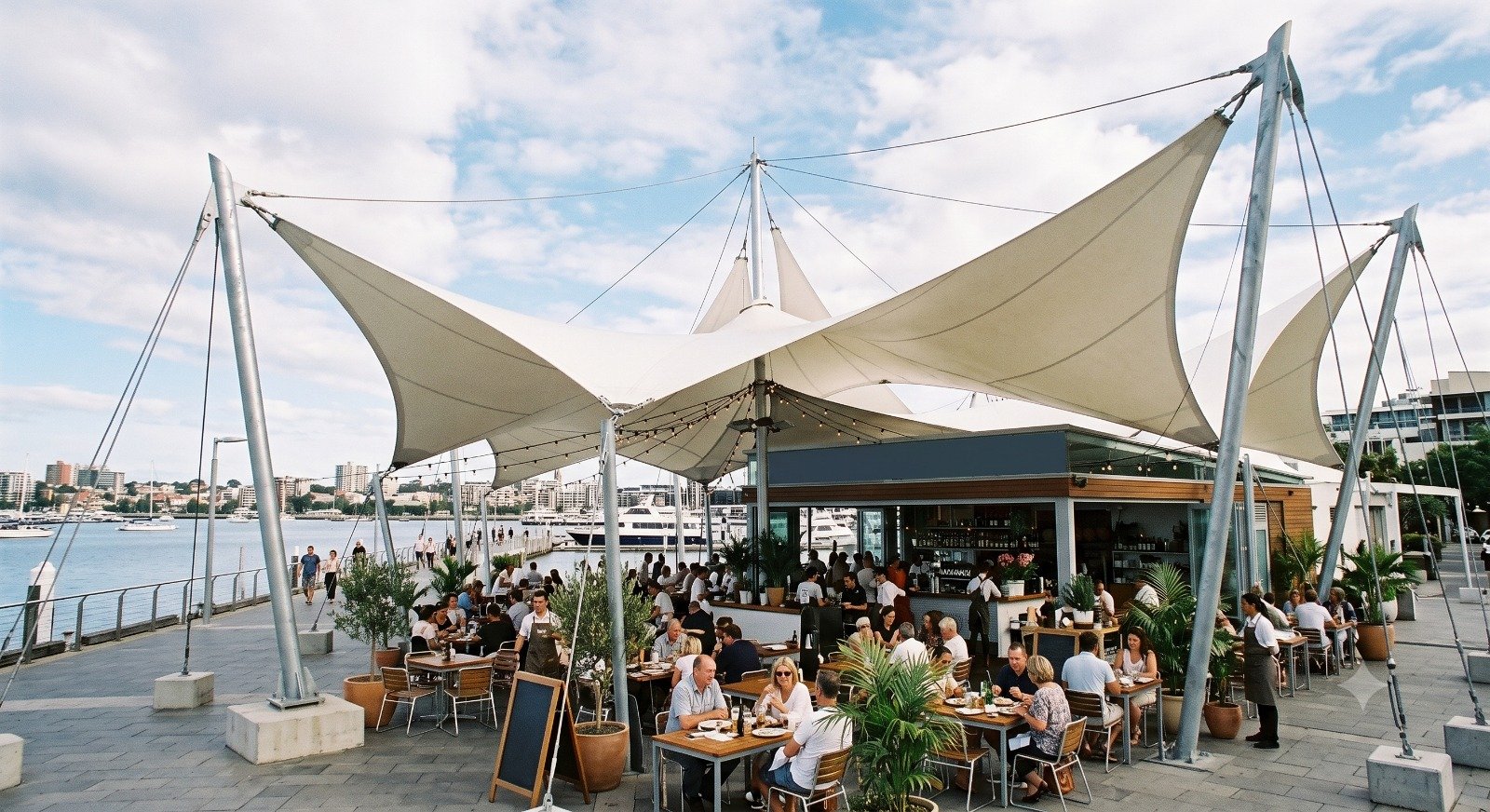
Tensile Structures for Restaurants: Why Outdoor Dining Is Going Architectural
Walk through any outdoor dining strip today — from a beachfront café to a rooftop lounge — and you'll notice the same shift happening almost everywhere. Umbrellas and temporary shades are giving way to something more permanent: sweeping, tensioned fabric canopies that look architectural rather than makeshift. This isn't just an aesthetic trend. It's a shift in how restaurant and café owners think about their outdoor space, and it's turning tensile structure for restaurants into one of the fastest-growing categories in export-driven technical textiles.
Why Restaurants Are Turning to Tensile Fabric Canopies
Outdoor dining used to mean compromise — shade that blew away in the wind, awnings that sagged after a season of rain, or rigid roofing that killed the open-air feel guests actually want. Tensile fabric canopies solve that compromise in one structure.
A cafe tensile canopy is built from a tensioned PVC or PVDF-coated fabric membrane stretched across a lightweight steel or aluminium frame. Because the fabric is under tension rather than resting flat, it naturally sheds rain, resists wind uplift, and holds its shape for years without sagging. For restaurant owners, that translates into a few very practical wins:
- Weatherproof, all-season seating — rain doesn't cancel outdoor dining anymore
- Fast installation — most canopy structures go up in days, not the weeks a masonry extension would take
- Distinctive architecture — curved, sail-shaped, and multi-peak designs give a restaurant a visual identity that a flat awning simply can't
- Lower long-term maintenance — a good outdoor dining fabric structure doesn't rust, crack, or need repainting the way traditional roofing does
- Better guest experience — natural light filters through the fabric during the day, while the same structure holds up string lighting and heaters comfortably at night
What Makes a Restaurant Canopy Fabric Different
Not every coated fabric is built for hospitality use, and this is where a lot of first-time buyers get it wrong. A restaurant canopy fabric supplier worth working with should be offering fabric engineered specifically for the demands of a dining environment — constant foot traffic underneath, exposure to cooking smoke and grease near kitchens, and a look that has to stay presentable, not just functional.
The fabric itself typically combines:
- A woven polyester base for tensile strength and tear resistance
- A PVC coating for waterproofing and flexibility across seasons
- A PVDF topcoat, which resists dirt, grease, and UV fading — genuinely useful near an outdoor kitchen or grill station, where a plain PVC surface would discolor within a couple of seasons
This is the same Tensile Membrane Structure technology used in far larger applications — stadium roofs, airport terminals, exhibition halls — scaled down and finished for a hospitality setting. The engineering doesn't change; only the footprint does.
A Growing Export Market
What's changed in the last few years is where the demand is coming from. Café and restaurant chains across the Middle East, Southeast Asia, and parts of Europe and Africa are increasingly specifying tensile fabric structures for new outdoor dining builds, rather than defaulting to steel-and-glass roofing or basic shade sails. That's opened up real export volume for manufacturers who can deliver European-grade coated fabric at a competitive price point.
India has become a significant part of that supply chain. As one of the established Fabrics Manufacturers and Supplier in India, Indian producers sourcing coated textile from established European mills are able to offer restaurant and hospitality clients abroad the same fabric quality used in landmark architectural projects, without the cost structure of manufacturing in Europe directly. For hospitality groups scaling across multiple countries, that combination of certified fabric quality and manufacturing flexibility is increasingly the deciding factor in who wins the contract.
What to Look for as a Buyer, Dealer, or Vendor
Whether you're a restaurant group evaluating your first outdoor structure or a dealer sourcing on behalf of hospitality clients, a few questions separate a good tensile structure for restaurants from one that will need replacing in three years:
- Where is the base fabric coated, and to what standard? Fabric from established European coating plants tends to hold color and strength far longer than uncertified alternatives.
- Is the design custom-engineered, or off a fixed template? Restaurant footprints are rarely uniform — a supplier who can custom-design around your seating layout will give you a better long-term fit.
- What's the fire and weather rating? For commercial hospitality use, this isn't optional — check certifications before signing off on any structure.
- Can the fabric handle grease and smoke exposure near kitchens? A PVDF-topcoated fabric holds up considerably better here than plain PVC.
- What does after-installation support look like? Fabric structures are low-maintenance, but not zero-maintenance — a supplier offering ongoing support is worth more than one offering the lowest quote.
For vendors and dealers building out a hospitality portfolio, this is also where margins are healthiest — restaurant and café clients tend to reorder as they expand to new locations, making tensile canopy supply a genuinely repeatable business line rather than a one-off sale.
Why Buyers Choose Lucky International
For restaurant groups, dealers, and hospitality contractors sourcing this kind of structure, the manufacturer behind the fabric matters as much as the design itself and this is where Lucky International has built its reputation.
Based in Mumbai, Lucky International works directly as a manufacturer, supplier, and exporter of custom-designed PVC and PVDF coated fabric Tensile Membrane Structure solutions, sourcing high-quality coated textiles from SIOEN's manufacturing plants in Belgium and France. That gives clients access to European-grade fabric light and heavy weight, corrosion-resistant, and finished for rough weather conditions without having to source or import it themselves.
A few reasons hospitality buyers and dealers keep coming back to Lucky International specifically:
- Custom design and implementation, rather than a fixed catalogue of standard shapes — each canopy is engineered around the actual seating layout and site conditions
- Decades of experience across India as specialists in tensile and PVC membrane structures, with restaurants and outdoor dining as one of their established application areas
- A wide project range beyond hospitality alone — car parking shades, auditoriums, walkways, entrances, sports halls, industrial constructions, and solar protection — which means the same engineering discipline used on large-scale projects carries over into restaurant-scale work
- Export-ready manufacturing, built for international clients who need reliable lead times and consistent fabric quality across multiple sites and countries
- Competitive, transparent pricing on tensile membrane structures, without compromising on the coated fabric quality that determines how long the canopy actually lasts
For a restaurant chain scaling to new cities, or a dealer building out a hospitality portfolio, that combination of European-sourced material and India-based manufacturing is a large part of why Lucky International keeps showing up as the supplier of choice.
Conclusion
The move toward tensile fabric canopies in outdoor dining isn't a passing design trend — it's a practical response to what restaurant owners actually need: weatherproof, low-maintenance, architecturally distinctive shade that goes up fast and lasts for years. As demand grows across international markets, sourcing decisions increasingly come down to fabric quality and manufacturing reliability rather than price alone.
Lucky International remains one of the go-to names in this space for exactly that reason — proven Tensile Membrane Structure engineering, European-sourced coated fabric, and export experience that hospitality brands can build on as they grow.
FAQ
How long does a tensile fabric canopy last for outdoor dining use?
A well-built tensile membrane structure using PVC or PVC/PVDF coated fabric typically lasts well over a decade with minimal maintenance, considerably longer than basic awnings or shade sails, which usually need replacing every few seasons.
Is a tensile canopy suitable for a restaurant near the coast or in a humid climate?
Yes. Coated fabric membranes are corrosion-resistant and handle humidity and salt air far better than metal roofing, which is part of why they've become popular for beachfront and coastal hospitality projects.
Can tensile structures be customized to match a restaurant's branding?
Yes. Beyond color choice, the shape, height, and panel design of a tensile canopy can be custom-engineered to fit a specific seating layout or architectural style, which is one of the main reasons hospitality brands prefer them over standard awnings.
Are tensile fabric structures cost-effective compared to permanent roofing?
Generally yes. Installation is faster and requires lighter foundations than masonry or glass roofing, and the low maintenance requirements over the structure's lifespan reduce long-term costs, even though the fabric itself is a premium material.
What should international buyers check before importing a tensile structure?
Confirm the coating standard of the base fabric, request fire and weather certification documentation, and clarify whether the design is custom-engineered for your site rather than a generic template — these factors matter more for durability than price alone.
Who manufactures export-quality tensile structures for restaurants in India?
Lucky International, based in Mumbai, manufactures, supplies, and exports custom-designed PVC and PVDF coated fabric tensile membrane structures, sourcing coated textile from SIOEN's plants in Belgium and France for hospitality and architectural projects across India and abroad.