


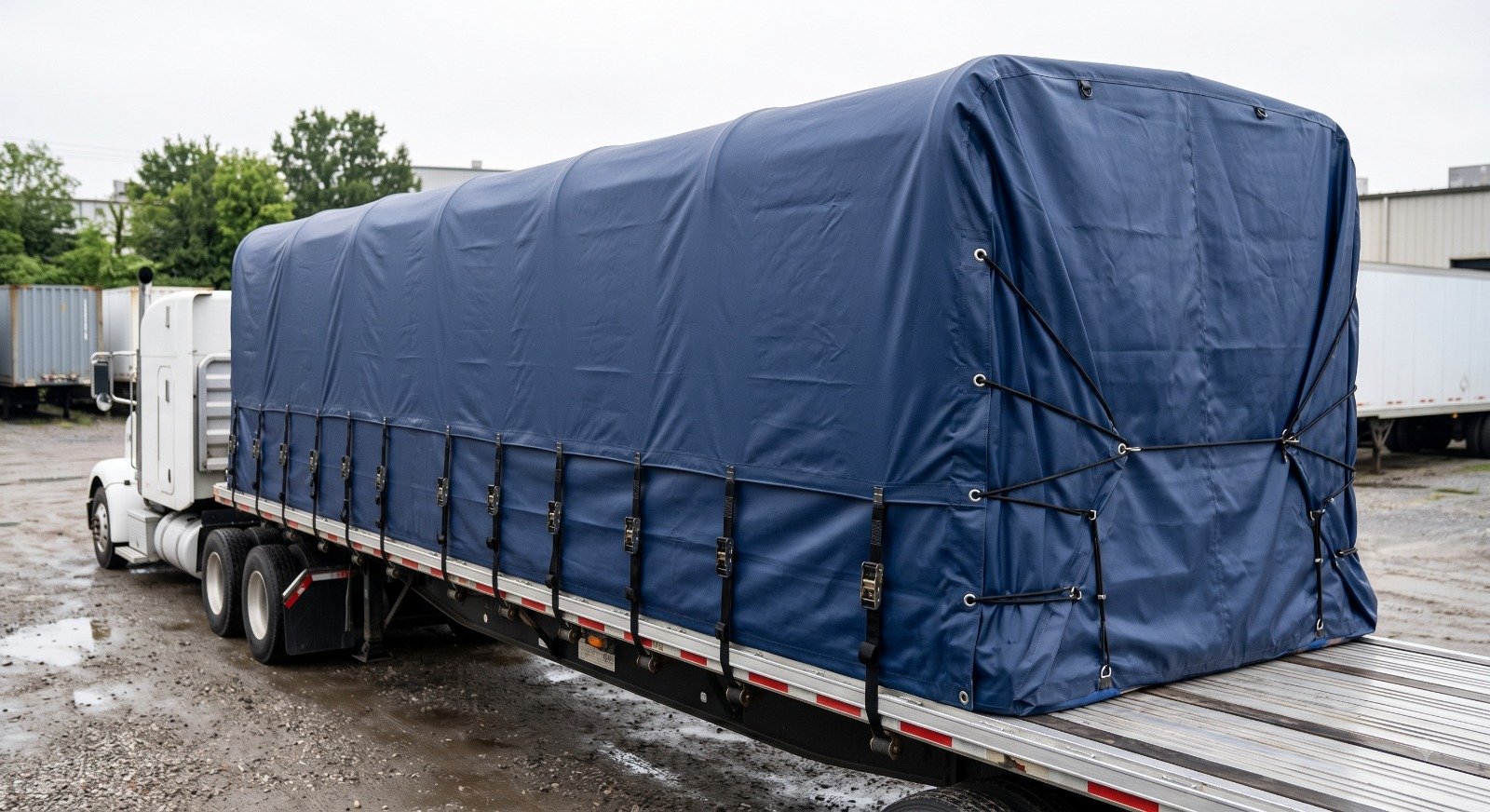
Tarpaulin for Truck Containers: What Export Cargo Protection Actually Needs
Cargo that looks fine leaving the factory doesn't always look fine arriving at port. Between highway vibration, monsoon downpours, dust on unpaved stretches, and hours parked in direct sun at a transit yard, a tarpaulin for truck containers is doing more work than most shippers give it credit for. Get the spec wrong and you're not just risking a damp consignment — you're risking a rejected export shipment and a client who doesn't reorder.
So here's what container cargo actually needs to survive transit, and what to check before you sign off on a supplier.
What Transit Actually Puts a Tarpaulin Through
A tarpaulin covering an open truck or a container in transit isn't sitting still. It's flapping at highway speed, getting UV-baked for hours in a yard, taking direct rain impact, and rubbing against straps, edges, and load corners the entire route. Most tarpaulin failures trace back to one of a handful of causes:
- Abrasion at tie-down points — repeated rubbing against rope, chain, or ratchet straps wears through coating long before the base fabric fails
- UV breakdown — untreated or low-grade PVC coating goes brittle and cracks within a season or two of constant sun exposure
- Seam failure — a tarpaulin is only as waterproof as its weakest weld; poorly heat-sealed seams are where most water ingress starts
- Coating delamination — cheaper coated fabrics separate from the base weave under repeated flexing, especially in cold-morning, hot-afternoon swings common on long highway routes
- Puncture and tear propagation — a small nick from a sharp load corner that isn't stopped by reinforced weave can spread into a major tear within a few hundred kilometers
What Export Cargo Protection Standards Actually Demand
Export shipments raise the bar because damage claims, insurance disputes, and customs holds all get more expensive once cargo crosses a border. A serious container cargo cover supplier should be able to speak to each of these without hedging:
- Fabric weight and denier. Heavier isn't automatically better, but for export-grade coverage, buyers should be looking at fabric weights suited to the load type — lighter for general dry cargo, heavier reinforced fabric for anything with sharp edges, machinery parts, or stacked pallets.
- Coating type. PVC-coated polyester is the standard for cost and durability balance; PVDF topcoats add UV and chemical resistance for routes with longer sun exposure or coastal humidity. For an export cargo tarpaulin headed through multiple climate zones on its way to port, the coating spec matters more than the base fabric weight.
- Waterproof rating and seam construction. Ask specifically about seam type — RF-welded seams generally outperform stitched-and-taped seams for long-term waterproofing, because stitching creates needle holes that become leak points over time.
- Tear and tensile strength. These numbers should come from actual test data, not a general claim of "heavy duty." A reputable logistics tarpaulin supply partner will have tensile and tear strength figures on hand for each fabric grade they offer.
- Eyelet and reinforcement spacing. Tie-down points need reinforced grommets set at spacing that matches standard strap positions on the trucks or containers actually being used — a mismatch here causes uneven tension and accelerated wear at the points that do get used.
Fabric Specification Cheat Sheet for Buyers
If you're issuing a spec sheet to a supplier rather than just asking for "a heavy tarpaulin," these are the numbers worth pinning down:
- Fabric weight (GSM) appropriate to load type
- Coating material — PVC vs PVDF — and coating weight per side
- Tensile strength and tear strength, tested per relevant standard
- Seam type and weld method
- UV stabilizer content, especially for routes with extended yard dwell time
- Grommet spacing and reinforcement patch placement
- Fire retardancy rating, if required by the destination market or carrier
Sourcing: Why the Supplier Relationship Matters as Much as the Spec
A spec sheet only protects you if the supplier actually manufactures to it consistently, batch after batch. This is where a lot of buyers get burned — the first shipment tests well, and the fifth one doesn't, because coating thickness or weld quality wasn't held to the same standard.
Lucky International works with logistics and export businesses on exactly this problem: consistent PVC and PVDF-coated tarpaulin fabric with documented coating specs, tested seam strength, and reinforcement built for the way trucks and containers actually get tied down and handled on Indian export routes. If you're evaluating Truck Cover & Tarpaulin Manufacturers, it's worth asking not just for a sample but for batch-to-batch consistency data — that's usually where the real difference between suppliers shows up.
For buyers managing recurring shipments rather than a one-off order, working with the same Lucky International team across orders also means less time re-explaining your spec every time a new batch goes out.
FAQs
What's the difference between PVC and PVDF-coated tarpaulins for export cargo?
PVC-coated fabric is the standard, cost-effective choice for most routes. PVDF topcoats add better UV and chemical resistance, which matters more on longer routes or in coastal, high-humidity conditions.
How long should a truck container tarpaulin last?
With a properly specified fabric and coating, a tarpaulin used regularly on export routes should hold up for several years before needing replacement cheaper, unspecified fabric can fail within a single season of heavy use.
Are RF-welded seams necessary, or is stitching enough?
For anything genuinely waterproof, RF-welded seams outperform stitched-and-taped seams over time, since stitching punctures the fabric and creates potential leak points.
What should I ask a tarpaulin supplier before placing a bulk order?
Ask for fabric weight, coating weight per side, tensile and tear strength data, seam type, and critically evidence of batch-to-batch consistency, not just a single good sample.