
-

Call Us Now
+91-9820325057 -

Opening Hours
Mon - Sat 09.00 - 06.30
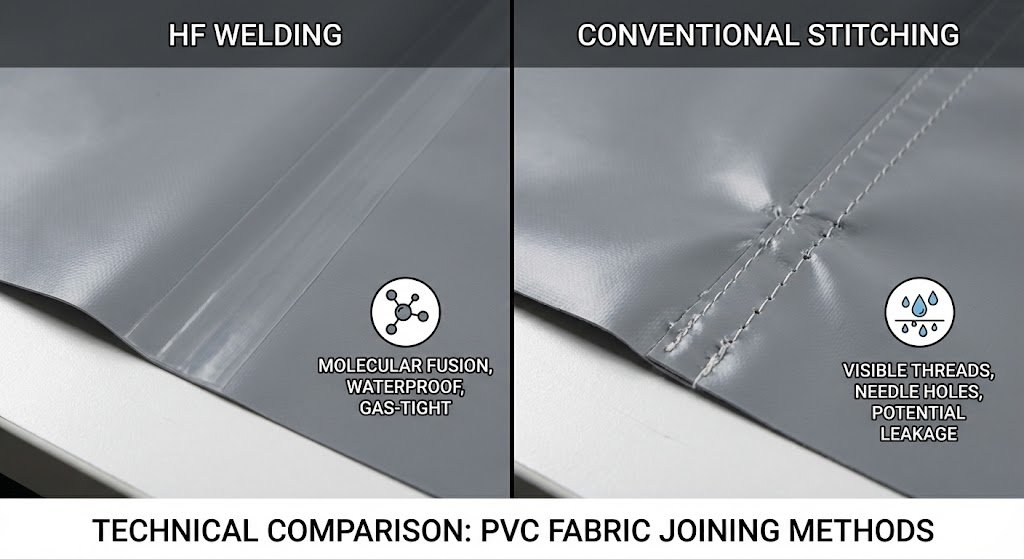
How Welding Quality Affects Fabric Life: HF Welding vs Conventional Stitching
How Welding Quality Affects Fabric Life: HF Welding vs Conventional Stitching
In high-performance applications such as tensile structures, biogas storage balloons, tarpaulins, industrial covers, awnings, and architectural membranes, the durability of PVC coated fabric depends not only on fabric quality — but also on how the fabric panels are joined.
Two commonly used joining methods dominate the industry today: HF (High Frequency) Welding and Conventional Stitching. While both are used widely, their impact on fabric lifespan, gas retention, waterproofing, and long-term performance is drastically different.
At LUCKY INTERNATIONAL, we manufacture European-quality PVC coated fabrics in exclusive partnership with SIOEN INDUSTRIES, BELGIUM, engineered specifically to perform optimally with advanced HF welding technology. This blog explains why welding quality matters and how HF welding outperforms conventional stitching in critical applications.
Table of contents :
- Why Joining Technology Matters in PVC Coated Fabrics
- What Is HF (High Frequency) Welding?
- What Is Conventional Stitching?
- HF Welding vs Conventional Stitching: A Performance Comparison
- Why HF Welding Is Critical for Biogas & Tensile Applications
- LUCKY INTERNATIONAL: Engineered for HF Welding Excellence
- Conclusion: Welding Quality Defines Fabric Performance
Why Joining Technology Matters in PVC Coated Fabrics
PVC coated fabrics are designed to withstand:
High tensile stress
Continuous outdoor exposure
UV radiation and harsh weather
Gas pressure (biogas and air structures)
Water, chemicals, and pollutants
However, weak joints can compromise even the best fabric.
Poor joining methods can lead to:
Seam leakage
Reduced fabric life
Delamination near joints
Gas loss in biogas balloons
Water seepage and premature failure
That is why welding quality is as important as fabric quality.
What Is HF (High Frequency) Welding?
HF Welding, also known as Radio Frequency (RF) Welding, uses high-frequency electromagnetic waves to melt and fuse PVC layers together at a molecular level.
Instead of puncturing the fabric, HF welding:
Softens the PVC coating
Bonds layers into a single, seamless joint
Creates joints as strong as or stronger than the fabric itself
This makes HF welding the preferred joining method for premium PVC coated fabrics.
What Is Conventional Stitching?
Conventional stitching uses threads and needles to mechanically join fabric panels.
While this method may be cheaper initially, it introduces several long-term disadvantages:
Needle holes weaken the fabric
Threads degrade faster than PVC
Seams are vulnerable to water, gas, and UV exposure
Stitching is still used in low-cost or short-term applications, but it is not suitable for high-performance or long-life structures.
HF Welding vs Conventional Stitching: A Performance Comparison
1. Seam Strength & Durability
HF Welding
Seam becomes part of the fabric
No perforation or structural damage
Extremely high tensile and peel strength
Conventional Stitching
Fabric is punctured by needles
Stress concentration around stitch holes
Higher risk of tearing under load
Winner: HF Welding
2. Waterproof & Gas-Tight Performance
HF Welding
100% waterproof seams
Excellent gas retention
Ideal for biogas balloons and gas holders
Conventional Stitching
Water can seep through stitch holes
Gas leakage over time
Requires sealants (temporary solution)
Winner: HF Welding
3. Fabric Life & Long-Term Reliability
HF Welding
Seam life equals fabric life
No thread degradation
Maintains integrity for years
Conventional Stitching
Threads deteriorate due to UV and chemicals
Seams fail before fabric
Shorter overall lifespan
Winner: HF Welding
4. Resistance to Harsh Indian Climate
HF Welding
Excellent performance in heat, humidity, and monsoon
No loosening or seam expansion
Conventional Stitching
Threads shrink, loosen, or break
Seams weaken in extreme weather
Winner: HF Welding
Why HF Welding Is Critical for Biogas & Tensile Applications
Applications such as biogas storage balloons, tensile roofs, membrane structures, and industrial enclosures demand:
Zero leakage
High internal pressure resistance
Long service life
Minimal maintenance
HF welding ensures:
Superior gas retention
Leak-free seams
Lower operational losses
Higher ROI over the fabric lifecycle
That is why HF welding is the industry standard for premium membrane projects worldwide.
LUCKY INTERNATIONAL: Engineered for HF Welding Excellence
At LUCKY INTERNATIONAL, our PVC coated fabrics are specifically engineered to deliver maximum performance with HF welding.
What Sets Us Apart:
Exclusive partnership with Sioen Industries, Belgium
Uniform PVC coating for consistent welding quality
Excellent adhesion between PVC and base fabric
High seam strength and durability
Proven performance in biogas, tensile, and industrial projects
Our membranes are trusted across India for projects that demand long life, safety, and performance without compromise.
HF Welding = Lower Maintenance & Higher Savings
While HF welding may have a higher initial cost, it offers:
Longer fabric life
Fewer repairs
Minimal downtime
Reduced gas and water losses
Better structural safety
In the long run, HF welded PVC coated fabric is far more cost-effective than stitched alternatives.
Conclusion: Welding Quality Defines Fabric Performance
No matter how premium a PVC coated fabric is, poor joining can destroy its performance.
If you want:
Longer fabric life
Leak-free operation
Superior gas retention
Reliable performance in Indian conditions
HF welding is the clear winner over conventional stitching.
And when combined with European-quality PVC coated fabrics from LUCKY INTERNATIONAL, the result is world-class performance built to last.
Contact Us Today
LUCKY INTERNATIONAL
Phone: +91-9820325057
Email: info@luckyinternational.net
Website: www.luckyinternational.net
LUCKY INTERNATIONAL — European Technology. Trusted Performance. Built to Last.
Get Your Free Quote Today!
Tell us about your project needs and we'll provide a custom quote.