


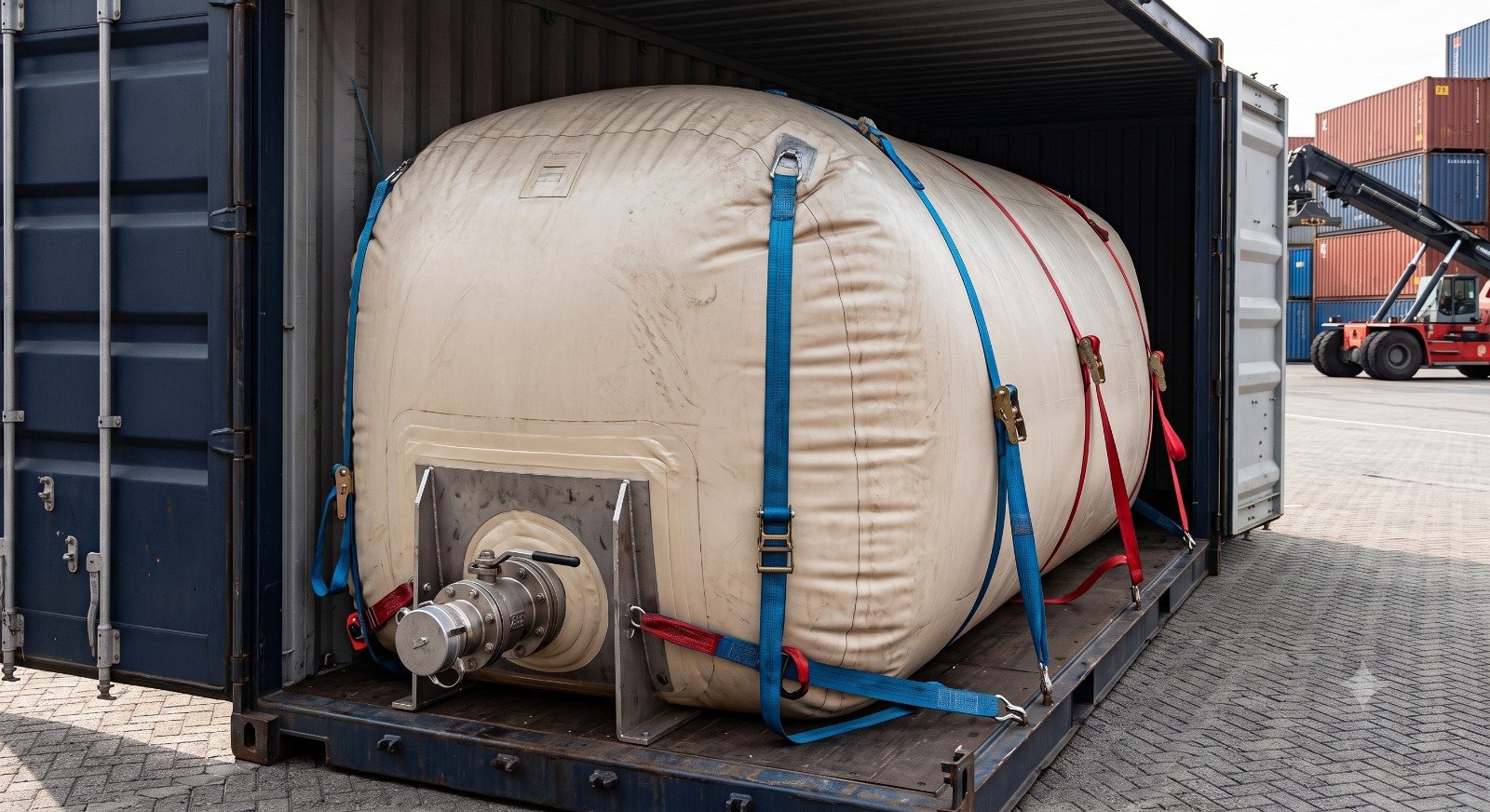
What Makes Coated Fabric Fit for Flexitank Use?
Move a large volume of liquid across a border, a shipping route, or just from a plant to a port, and you find out fast whether your flexitank fabric was actually built for the job. A tank that looks fine folded flat in a warehouse can behave very differently once it's loaded with tonnes of liquid, strapped inside a container, and jolted around for days on a truck, a ship, and a rail line. The fabric is what stands between that liquid and a very expensive cleanup, so it's worth understanding what actually makes coated fabric fit for flexitank use — and what doesn't.
The Basic Job a Flexitank Fabric Has to Do
A flexitank isn't a rigid container. It's a flexible bladder built from coated fabric that has to hold its shape and integrity under constant, shifting load — full when loaded, sloshing in transit, and stressed at every fold and seam. That means the fabric has to manage several jobs at once: contain the liquid without leaking, resist the chemical makeup of whatever's inside, survive rough handling, and still fold down small enough to be practical to ship and store when empty.
Get any one of those wrong and the whole tank underperforms, no matter how strong the rest of it is.
Core Properties That Make Coated Fabric Flexitank-Ready
Chemical and product compatibility Not every liquid behaves the same way against a coating. Fabric that holds up fine against water-based liquids can degrade quickly against oils, solvents, or acidic contents. A proper flexitank fabric is engineered with a coating chemistry matched to the liquid it's meant to carry, so it doesn't soften, swell, or break down in contact with the product.
Tensile strength and seam integrity The base scrim — usually a woven polyester or nylon fabric — carries the load, while the coating provides the barrier. Under full load, the fabric is under constant tension, and the seams take even more stress than the flat panels. Fabric that's engineered for flexitank use is built with tensile strength that matches the weight it's designed to carry, and it's welded rather than stitched, so the seam is as strong as the fabric around it.
Flexibility without weakness A flexitank has to fold, flex, and conform to the shape of a shipping container without cracking at the folds. Coated fabric built for this application stays pliable across a wide temperature range, so it doesn't stiffen and crack in cold transit conditions or go soft and lose shape in heat.
Puncture and abrasion resistance Loading, unloading, and the general handling a flexitank goes through inside a container is not gentle. The fabric needs enough abrasion resistance to survive contact with the container floor and walls, straps, and loading equipment without weakening at contact points.
Barrier performance Beyond just "not leaking," a good flexitank fabric maintains a consistent barrier against moisture ingress, contamination, and — depending on the product — oxygen or vapour transfer, so what goes in at the origin is what comes out at the destination.
Non-toxic, product-safe coating For food-grade liquids, juices, wine, and similar contents, the coating itself has to be safe for contact with what it's carrying, with no leaching or tainting of the product over the length of a shipment.
Why This Matters More for Bulk Transport Than Almost Any Other Application
A small puncture in a tarpaulin is inconvenient. A small failure in a flexitank carrying a bulk liquid shipment is a different scale of problem entirely — product loss, contamination risk, container damage, and delays that ripple through a supply chain. That's exactly why coated fabric for flexitank transport can't be treated as an off-the-shelf commodity. It has to be specified against the actual liquid, volume, and route it's going to see.
Sourcing Coated Fabric for Flexitank Use
Working with a flexitank fabric supplier that understands both the fabric side and the logistics side of the equation makes a real difference. Lucky International, part of a group counted among establishedPVC & PVDF Coated Fabric Manufacturers and known more broadly as Fabrics Manufacturers and Supplier across a wide range of technical textile applications, supplies coated fabric for flexitanks and other liquid containment solutions built around the specific product and route requirements of the shipment. As one of the Flexi Tank fabric Manufacturers working directly with businesses moving bulk liquid, the focus stays on getting the fabric chemistry, strength, and construction right for the cargo it will actually carry — not on selling a generic roll and hoping it fits.
If you're planning bulk liquid transport and want the fabric matched properly to your product, it's worth having that conversation with a supplier before the flexitank is built, not after a shipment has already gone wrong.
Frequently Asked Questions
What fabric is used to make a flexitank?
Flexitanks are typically built from coated technical fabric — a woven polyester or nylon base combined with a PVC or PVDF coating — engineered for liquid containment, chemical resistance, and flexibility under load.
Can the same flexitank fabric carry any liquid?
No. Coating chemistry needs to be matched to the specific liquid — water-based, oil-based, food-grade, or chemical products all place different demands on the fabric, and using the wrong fabric for the wrong product can lead to degradation or contamination.
What causes flexitank failures during transport?
Most failures trace back to weak seams, fabric not suited to the cargo's chemical properties, or fabric that isn't flexible or abrasion-resistant enough for handling and folding during loading and transit.
Are flexitanks reusable?
Flexitanks are generally designed as single-use for a bulk liquid shipment, since the fabric and seams are optimised for one full load cycle rather than repeated fill-and-empty use.